BangleNet: From 45% to 85% — How a Bangladesh-Born Technology Initiative Is Building an Entire Digital Economy Ecosystem
4 November 2026
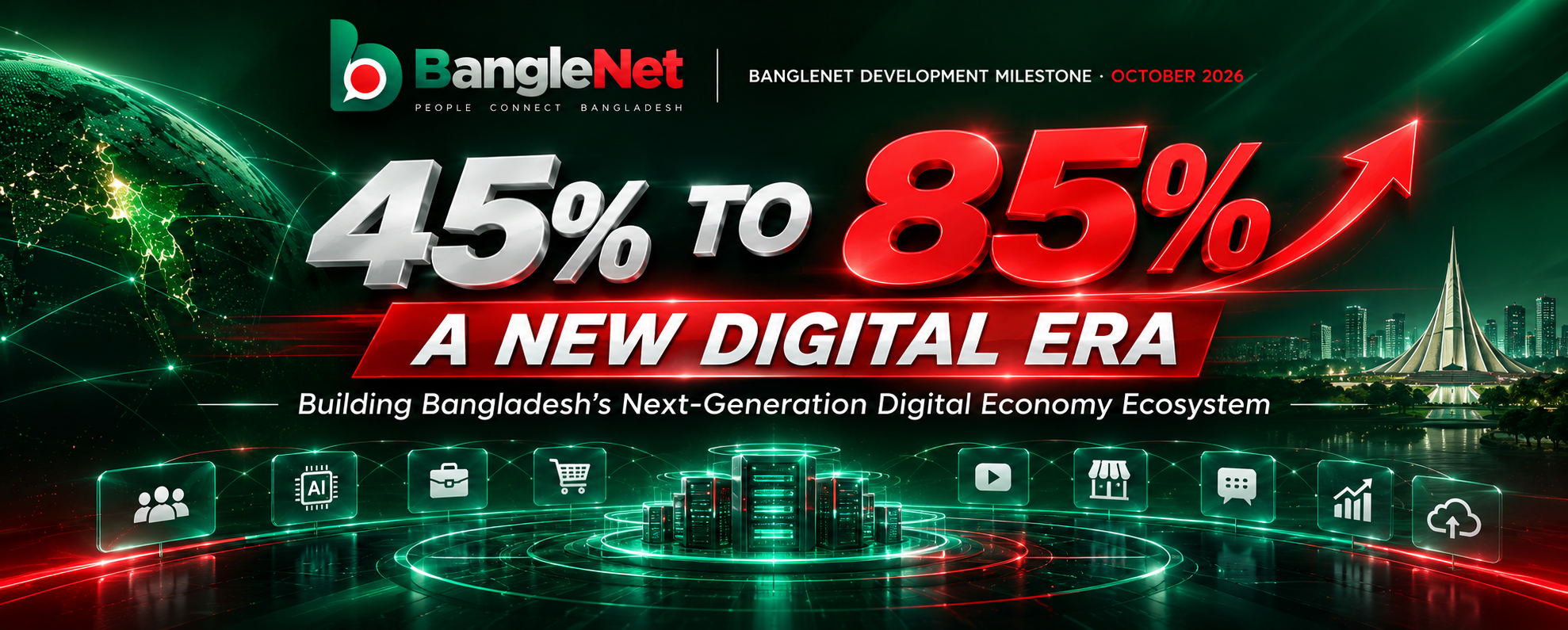
On October 3, 2026, Senpai Design Solutions introduced a major development milestone for BangleNet: approximately 45% completion.
At that time, the central idea was already ambitious. Instead of building another conventional social networking application, BangleNet was being designed as an integrated digital ecosystem connecting social networking, creators, businesses, professional identities, employment, e-commerce, communities, events, messaging and digital management.
But the story did not stop there.
By October 27, 2026, the project's internal development assessment had reached approximately 85%.
That represents a significant 40-percentage-point progression in the project's reported development journey. More importantly, the development focus had expanded beyond the initial social-platform experience into deeper business infrastructure, organizational management, backend services, workforce operations, logistics foundations, streaming architecture, security boundaries and interconnected platform services.
BangleNet is being developed by Senpai Design Solutions, with strategic collaboration from Zaker IT Solutions. Its ambition is to establish a technology ecosystem originating in Bangladesh, designed for local economic realities while maintaining the architectural direction necessary for international expansion.
The central question is no longer simply whether Bangladesh can build another social platform.
The larger question is whether Bangladesh can build a connected digital environment in which people can socialize, businesses can operate, organizations can manage their activities, creators can develop their careers, employers can recruit talent and consumers can participate in digital commerce—all within one interconnected ecosystem.
That is the ambition behind BangleNet.
1. The Fundamental Shift: From Social Media to Digital Infrastructure
Most conventional digital platforms focus on one primary activity.
One platform connects friends. Another distributes videos. Another helps professionals find employment. Separate services provide online stores, advertising, business management, recruitment, event management and communication.
For an individual or business, this creates a fragmented digital existence.
A small business might need:
A website and domain.
A hosting provider.
A social media presence.
A product management system.
A customer communication platform.
An advertising account.
Analytics and reporting tools.
Recruitment services.
Inventory management software.
Separate payment and order-management infrastructure.
Every additional service introduces another subscription, another interface, another learning curve and another operational dependency.
BangleNet is designed around a different model.
Instead of treating these activities as isolated products, it aims to connect them through a shared identity, shared discovery environment, interconnected business services and a unified digital experience.
A person can participate as a regular user, content creator, professional, employee, employer, seller, customer or community organizer.
A business can establish its presence, publish content, reach customers, advertise, recruit employees and participate in commerce.
An organization can manage people, communicate with its members and coordinate its activities.
The platform's long-term ambition is to make these interactions work together instead of forcing people to rebuild their digital presence across unrelated services.
This is the difference between building another application and attempting to develop a digital ecosystem.
2. The Social Networking Ecosystem
Social networking remains the foundation of BangleNet, but the platform's design philosophy extends beyond a conventional scrolling feed.
The ecosystem is intended to support multiple forms of interaction and content discovery.
A connected social identity
The platform is designed around a broader digital identity that can connect a person's social activity, professional presence, creator profile, communities and business interactions.
Instead of maintaining completely disconnected identities for different activities, users can participate across multiple experiences within the same platform.
A more transparent discovery experience
BangleNet's discovery philosophy includes:
For You.
Following.
Latest.
Personalized discovery.
User-controlled content preferences.
Transparent recommendation explanations through the concept of "Why am I seeing this?"
More meaningful control over the content users encounter.
The objective is to make recommendation systems more understandable and give users greater influence over their digital experience.
Posts, reactions and engagement
The broader social experience includes content publishing, reactions, comments, sharing, audience interaction and content-level discovery.
The platform's intended analytics model also distinguishes between different forms of engagement.
For example, Reach, Impressions and Views are not treated as interchangeable measurements. They represent different aspects of content distribution and audience behaviour.
Pages and Groups
Pages are intended to provide public identities for businesses, creators, organizations and other entities.
Groups and communities provide spaces for people with shared interests, professional goals, educational needs or organizational relationships.
The objective is to make these spaces useful beyond simple content posting.
Stories and Reels
Short-form and temporary content are part of the platform's creator and social experience.
These systems require more than upload buttons. They involve media processing, content delivery, audience interaction, visibility controls, analytics and moderation.
The development of these experiences remains an important part of the remaining implementation and refinement work.
3. Messenger: Communication as a Core Platform Service
Communication is essential to any interconnected digital ecosystem.
BangleNet Messenger is intended to support dynamic conversations rather than acting as a basic text-message feature.
Its planned and developing capabilities include:
Text messaging.
Image and photo sharing.
Video sharing.
File attachments.
Voice and audio messages.
Message reactions.
Group conversations.
Group membership management.
Administrative roles and permissions.
Message privacy and visibility controls.
Rich conversation interfaces.
The interface direction includes desktop floating multi-chat experiences and a full-screen mobile conversation experience.
The development scope also includes more advanced message interactions, such as view-once content, message starring and richer conversation discovery.
Importantly, the defined Messenger scope does not include voice or video calling.
The objective is to build a connected communication environment that can serve social relationships, business interactions, recruitment conversations, customer support and community coordination.
A customer discovering a product should be able to communicate with its seller.
A recruiter should be able to interact with a candidate.
A community member should be able to communicate with an organization.
Communication becomes part of the platform's operating infrastructure rather than a disconnected feature.
4. Live Streaming: Building a Real-Time Creator Environment
Live streaming introduces a different level of technical complexity.
A production-oriented live system must coordinate broadcasting, media delivery, viewer sessions, real-time interactions, moderation and content lifecycle management.
BangleNet's Live development has progressed into dedicated backend and interface work.
The engineering work includes:
Live session management.
Co-host permission foundations.
Preview and retention state management.
Viewer-facing live experiences.
Real-time chat and interaction concepts.
Live reaction experiences.
Camera and screen-sharing capabilities.
Picture-in-picture support.
Orientation handling.
Post-live retention rules.
The live architecture has been developed across migrations 0085–0089, including camera, screen-sharing and picture-in-picture foundations.
The planned viewing experience includes a dedicated chat area and real-time reactions, with a target latency design of approximately 30 seconds.
A different approach to live recording retention
One particularly important product decision concerns what happens after a live broadcast ends.
The retention policy is designed to avoid automatically retaining the entire original live recording indefinitely.
The intended outcomes are:
Delete the full live recording from R2 after the session ends; or
Retain only a user-edited highlight of no more than five minutes.
This creates a more deliberate content-retention model and avoids treating every complete live broadcast as permanent platform storage.
The remaining challenge is to ensure that broadcasting, delivery, viewer synchronization, moderation and media lifecycle management operate reliably together at scale.
5. Marketplace and E-Commerce: Reducing the Cost of Entering the Digital Economy
One of BangleNet's most important economic ambitions lies in commerce.
For many small businesses, entering the online market can require significant investment.
A seller may need a website, hosting, product catalogue, payment integration, marketing channels, customer support and analytics before reaching the first customer.
This creates a barrier for smaller entrepreneurs.
BangleNet aims to reduce that barrier through an integrated marketplace and business ecosystem.
A connected commerce journey
The intended experience connects:
Business identity and Pages.
Product discovery.
Storefront experiences.
Product listings.
Customer communication.
Community-driven discovery.
Content-based product promotion.
Order-related workflows.
Business analytics.
Commercial advertising.
Instead of treating content and commerce as separate activities, the ecosystem aims to connect them.
A customer might discover a product through a creator, encounter a business through a community, visit its storefront, communicate with the seller and proceed through the available commerce workflow.
A small business could establish an online presence without independently building every component of its digital infrastructure.
The commercial model
The platform's proposed monetization structure includes a 10% commission on the order subtotal, excluding delivery charges.
This model is intended to align platform revenue with actual commercial activity rather than depending exclusively on advertising.
However, transaction processing, payment integrations, dispute management, refunds, seller verification and financial reconciliation remain important implementation and operational requirements.
The larger opportunity
The real opportunity is not simply creating another online marketplace.
It is connecting commerce with social distribution, communication, creator activity, business identity and customer communities.
That connection could make digital commerce more accessible to entrepreneurs who cannot afford a complete independent technology stack.
6. Jobs and Professional Infrastructure: Beyond a Vacancy Board
Employment is another major pillar of BangleNet.
The objective is not to create a basic job-listing section where organizations publish vacancies and applicants upload CVs.
The broader direction is a connected professional and employment ecosystem.
Its planned capabilities extend across:
Professional identities.
Employer Pages.
Job discovery.
Recruitment workflows.
Applicant management.
Candidate profiles.
Portfolio and professional presentation.
Talent discovery.
Freelance opportunities.
Professional communities.
Recruitment communication.
Organizational interaction.
The longer-term ambition includes more advanced applicant-tracking and recruitment-management capabilities.
Why this matters
Bangladesh has a large population of young people entering the workforce, along with freelancers, students, professionals and businesses searching for talent.
A fragmented recruitment environment can make it difficult for candidates to discover legitimate opportunities and for employers to reach suitable people.
A connected employment ecosystem could help bridge this gap.
A professional could build an identity, develop a portfolio, participate in relevant communities, discover opportunities and communicate with employers without constantly moving between unrelated services.
Businesses could use their digital presence to establish credibility, publish vacancies and interact with potential employees.
The proposed monetization model includes a ৳100 job-posting fee, with hiring access intended to be restricted to verified Pages.
Verification is particularly important because employment platforms must take fake vacancies, impersonation and recruitment fraud seriously.
BangleNet's ambition is to make professional networking, recruitment and employment discovery parts of the same digital journey.
7. ERP and Business Management: Moving Beyond Social Media
One of the most significant developments beyond the original 45% announcement is the expansion of BangleNet's business and organizational infrastructure.
ERP stands for Enterprise Resource Planning.
Traditionally, businesses use separate software systems to manage employees, departments, property, logistics, inventory, expenses, approvals and operational records.
BangleNet's wider business ecosystem is intended to connect these kinds of organizational capabilities with its social, commercial and professional services.
This is an important distinction.
The ambition is not merely to let a business advertise on BangleNet. It is to give businesses and organizations a broader digital operating environment.
Workforce management
A major workforce engineering milestone was completed in October 2026.
The workforce foundation includes:
People records.
Employee-oriented workflows.
Shifts.
HR-related structures.
Departments.
Organizational access and permissions.
API and database integration.
Management interfaces.
English and Bangla localization foundations.
The workforce implementation was delivered through migrations 0119–0124.
The October 23 engineering report recorded:
130/130 database probe checks passed.
16/16 PostgREST checks passed.
25 endpoints returned the expected 401 response for anonymous access.
48 permission guards.
1,518 tests across 108 files passed.
TypeScript checking and production build completed cleanly for that reported stage.
These results apply to the reported workforce milestone, not to every BangleNet module.
Property management
The property-management stage was also reported complete, with database foundations delivered through migrations 0115–0118.
This extends the organizational direction beyond people management into the management of business-related assets and property records.
Fleet and logistics foundations
Another important development area is fleet management.
The fleet database foundation was introduced through migration 0125.
Its engineering work includes:
Monotonic odometer handling.
Generated trip-distance calculations.
Append-only fuel ledger foundations.
Database integrity checks.
The database probe for this stage recorded 86/86 successful checks.
However, the complete fleet application layer, management interfaces and integration were still being developed at that reporting point.
Warehouse, stock and returns
The subsequent Stage 17c work expanded the business infrastructure into warehouse and returns management.
Its scope includes:
Warehouse services.
Stock placement.
Goods returns.
Restocking.
Write-off workflows.
Permission-aware operations.
Service and route integration.
Management panels.
This is part of the transition from isolated organizational modules toward a broader ERP-style business environment.
The wider ERP roadmap
The wider business-management roadmap also includes areas such as:
Asset management.
Documents.
Approvals.
Warehouse operations.
Returns.
Expenses.
Payouts.
Recipes and operational records.
These should be understood as an expanding ERP roadmap, not as a claim that every module is already complete.
The significance is that BangleNet is moving toward a model in which an organization can use the same ecosystem for public communication, recruitment, commerce and internal operations.
8. Emergency Infrastructure: Social Technology with a Human Purpose
A particularly meaningful part of the platform's direction is the Emergency system.
The concept introduces a dedicated emergency entry point on a user's profile.
The intended emergency categories include:
Blood requirements.
Climate-related assistance.
Missing-person assistance.
Other urgent community-support situations.
An emergency request is designed to become visible through the relevant feed and notification systems.
Blood assistance and escalation
The blood-support workflow is designed around structured matching and geographical relevance.
The intended escalation sequence is:
Notify relevant users in the local area.
Expand discovery toward users with matching blood groups.
Extend the search toward nearby blood banks.
Connect relevant verified pharmaceutical or healthcare Pages where appropriate.
This requires more than a simple post.
It involves:
Blood-group matching.
Geographic proximity.
Priority ranking.
Notification delivery.
Timed escalation.
Resource discovery.
Availability and response tracking.
Importantly, this functionality is intended to use deterministic algorithms, matching rules and geospatial logic rather than relying on an external AI API.
The broader principle is that a social platform should be capable of helping communities coordinate around meaningful real-world needs, not only entertainment.
9. Platform Safety: A More Responsible Digital Environment
A large digital platform must consider more than growth.
It must also address harmful content, abuse, impersonation, harassment, privacy and user protection.
BangleNet's moderation direction includes an anti-18+ content policy and a structured approach to platform safety.
The intended moderation architecture emphasizes:
Deterministic content rules.
User-initiated reporting.
Moderation workflows.
Human review where automated rules are uncertain.
Strike and appeal mechanisms.
Protection against harmful or exploitative material.
Additional safeguards for younger users.
Moderation-aware content and advertising eligibility.
The objective is to avoid making unrestricted distribution the default.
A responsible platform needs clear rules, predictable enforcement and meaningful review procedures.
The full moderation system must continue to be implemented, tested and operationally validated before these ambitions can be presented as complete platform capabilities.
10. Advertising: Reimagining Digital Marketing and Business Discovery
One of the biggest economic opportunities within BangleNet is its potential to change how businesses approach digital marketing.
Traditional digital marketing often requires businesses to maintain separate channels for audience building, paid advertising, content distribution, analytics and customer communication.
Small businesses can struggle with the complexity and cost.
BangleNet aims to connect these activities.
Business Pages as marketing infrastructure
A business can establish a Page, publish content, develop an audience, participate in communities, promote products and communicate with customers.
The Page becomes more than a profile.
It is intended to function as a business-facing digital presence.
BangleNet Ads Manager
The platform's advertising direction includes a dedicated Ads Manager experience.
The proposed ecosystem includes:
Campaign creation.
Advertising objectives.
Audience targeting.
Campaign performance reporting.
Business promotion.
Sponsored content.
Advertising review and moderation.
Advertiser-facing analytics.
The longer-term direction also includes making campaign setup more accessible through natural-language business objectives and AI-assisted interpretation of advertiser goals.
For example, a business could explain that it wants to increase product enquiries or promote a new storefront, and the system could help translate that objective into a structured campaign setup.
This AI-assisted business and advertising direction should be understood as an evolving product ambition, not a claim that a fully autonomous AI business operator is already deployed.
Native advertising and monetization
The advertising model is intended to integrate sponsored content into the platform experience.
A proposed feed strategy includes native sponsored placements at controlled intervals, rather than overwhelming users with advertising.
The wider monetization direction includes:
Sponsored business content.
Advertising campaigns.
Verified business services.
Job-posting fees.
Marketplace commissions.
Premium animated profile badges.
Future creator and business monetization opportunities.
Premium animated badges have been discussed in a proposed ৳69–৳567 monthly pricing range.
These are monetization proposals and should not be interpreted as proof of an established revenue stream.
Why this could change marketing
If a business can establish its identity, build an audience, promote products, communicate with customers, recruit employees and sell through one ecosystem, the cost and complexity of entering digital marketing could decrease.
That does not mean every advertising agency or marketing channel becomes unnecessary.
It means that the digital marketing journey could become more integrated and accessible, particularly for small businesses.
11. The AI Business Handler: A New Direction for Business Operations
The longer-term BangleNet vision also includes AI-assisted business operations.
The concept of an AI Business Handler is to move beyond conventional chatbots that simply answer questions.
Instead, the ambition is to develop a business-oriented assistant that can help interpret business objectives and interact with relevant platform services.
Potential areas include:
Business information and Page management.
Campaign planning.
Product and service discovery.
Customer communication assistance.
Business reporting.
Operational guidance.
Recruitment-related assistance.
Workflow coordination.
The critical distinction is between an assistant that merely provides suggestions and an operational system that can interact with authorized business workflows.
A trustworthy implementation would require permissions, human confirmation for consequential actions, audit trails, privacy safeguards and reliable integration with the underlying business services.
The vision is to make advanced business tools more accessible to entrepreneurs who may not have dedicated technical teams.
12. Marketing Without Building an Entire Website First
One of the most significant potential changes is how small businesses establish themselves online.
Today, a business may believe that it must build a website before it can operate professionally online.
That can involve domain registration, hosting, design, development, product management, security, maintenance and marketing.
BangleNet aims to reduce this initial barrier.
A business could potentially:
Establish a business Page.
Build its digital identity.
Publish products and services.
Develop an audience.
Participate in relevant communities.
Promote content.
Communicate with potential customers.
Use marketplace services.
Recruit employees.
Measure its audience and campaign performance.
This could make digital participation significantly more accessible to smaller entrepreneurs.
A seller may not need to commission a complete e-commerce website before testing whether a product has market demand.
A local business may be able to build an audience before investing in a standalone digital property.
A creator may develop a community and business presence without managing multiple disconnected services.
However, independent websites will remain important for businesses that require custom applications, full control of their infrastructure, independent search visibility, proprietary customer systems or specialized checkout experiences.
BangleNet's ambition is not to eliminate the web.
It is to make the first steps into the digital economy easier and reduce unnecessary dependence on separate services.
13. SFX, VFX and the User Experience Layer
A modern digital platform is not defined only by its backend capabilities.
Its experience also depends on how people interact with it.
BangleNet's interface and experience direction includes more dynamic interaction design, visual feedback, transitions, animation and responsive behaviour.
The broader experience roadmap includes:
Reaction animations.
Notification feedback.
Messaging interaction effects.
Story and Reels transitions.
Live interaction effects.
Loading and navigation states.
Contextual interface animations.
Visual effects and media editing experiences.
Sound effects for relevant interactions.
These are not merely decorative elements.
Well-designed feedback can make complex workflows easier to understand, improve interaction clarity and create a more coherent product identity.
The challenge is to deliver these experiences without compromising accessibility, performance or responsiveness on lower-end devices.
14. Technical Architecture and Platform Engineering
The scale of BangleNet's ambition requires a serious technical foundation.
The development stack includes Next.js, Supabase, Vercel infrastructure and object-storage systems, with Cloudflare R2 included in the media-storage strategy.
The platform's engineering direction includes:
Database-backed application services.
Authentication and authorization.
Row-level security.
API-level access control.
Modular service architecture.
Structured database migrations.
Persistent user data.
Media storage and delivery.
Permission-aware organizational workflows.
Background processing.
Notifications.
Operational and performance monitoring.
The database and API layers are important because BangleNet is not simply a collection of frontend screens.
Its features must share data, enforce permissions and coordinate operations across different parts of the ecosystem.
Security and access boundaries
The workforce milestone included 48 permission guards and endpoint verification demonstrating that anonymous users received unauthorized responses from 25 tested endpoints.
The engineering work also involved database probes, PostgREST checks, TypeScript validation and automated testing.
These are important foundations, but platform-wide security still requires comprehensive testing across every service, integration and user journey.
Scaling beyond the first users
BangleNet's infrastructure strategy is progressive.
The initial deployment is intended to operate through managed cloud infrastructure, with capacity determined through load testing and actual usage.
The roadmap includes:
Optimized database operations.
Capacity planning.
Media storage and delivery optimization.
Workload management.
Caching.
Security monitoring.
Infrastructure expansion.
Evaluation of dedicated computing resources.
Longer-term exploration of locally controlled server infrastructure and data-center capabilities.
The first 100,000 users represent an important capacity-planning milestone, not an independently verified performance guarantee.
The longer-term ambition is to build increasing infrastructure capacity as the platform grows, rather than assuming that one server configuration can support unlimited demand.
15. What Has Changed Since the 45% Milestone?
The most meaningful changes are not simply additional menu items.
They represent a shift toward deeper operational infrastructure.
Development area
Progress and significance
Social ecosystem
Broader interconnected social and discovery architecture
Messenger
Advanced communication and conversation-management scope
Live
Dedicated streaming backend foundations and media lifecycle work
Stories and Reels
Media and creator experience development continues
Emergency
Structured community-support workflows and matching logic
Workforce
Major implementation milestone completed and tested
Property
Database and application milestone reported complete
Fleet
Database foundation delivered; application integration remains
Warehouse and returns
Stage 17c application-layer work underway
Marketplace
Commerce and business ecosystem development
Jobs
Professional identity and recruitment ecosystem direction
Advertising
Ads Manager and business monetization architecture
Moderation
Safety and anti-18+ policy development direction
AI Business Handler
Longer-term AI-assisted business-operation direction
User experience
Interface refinement, interaction design and visual polish
The workforce milestone provides one of the clearest examples of the increased engineering depth after the original announcement.
Migrations 0119–0124, 130 successful database probes, 16 successful PostgREST checks, 1,518 passing tests across 108 files and clean TypeScript/build results were reported for that specific stage.
The property and fleet foundations also show that the platform's ambitions are expanding into organizational operations rather than remaining confined to social networking.
16. A New Opportunity for Bangladesh's Small Businesses
The economic importance of BangleNet becomes clearer when viewed against Bangladesh's business landscape.
According to reporting based on the SME Foundation's analysis of the Bangladesh Bureau of Statistics' Economic Census 2024, micro, small and medium enterprises account for nearly 99% of industrial establishments and employ more than three crore people. The same analysis places their contribution at around 30% of the economy.
This demonstrates why accessible digital infrastructure for smaller businesses matters.
If businesses can establish a digital presence, reach customers, communicate, recruit and sell without first investing in multiple independent technology systems, the barrier to digital participation could be reduced.
BangleNet's potential contribution lies in connecting these activities.
It could help a local seller move from informal social-media selling toward a more structured business presence.
It could help a growing company connect recruitment, employee operations and customer acquisition.
It could provide creators with additional opportunities to build audiences and commercial relationships.
It could give local communities a structured environment for communication and organization.
No single platform can automatically solve the structural challenges of a national economy. But an effective digital ecosystem can become one useful part of the infrastructure that supports economic participation.
17. The Creator Economy: From Audience Building to Business Opportunities
Creators are not simply content publishers.
They are increasingly entrepreneurs, educators, entertainers, community leaders and business operators.
BangleNet's creator direction is designed around a connected identity that can bring together content distribution, audience development, communities, professional presence and future monetization opportunities.
One of the most ambitious launch concepts previously discussed is a creator competition involving more than 1,000 established YouTube creators.
The proposed challenge would encourage creators to build their BangleNet audiences, with the objective of becoming the first to reach one million followers.
The proposed prize pool is ৳1,000,000 for the top three positions.
Another proposed recognition initiative would introduce a distinctive physical award for creators reaching 500,000 or more followers.
These are planned campaign concepts, not completed events.
If executed successfully, such initiatives could create a substantial creator-led launch campaign while giving Bangladeshi creators another distribution environment.
The broader ambition is to make the creator ecosystem commercially and professionally useful—not simply another place to upload videos.
18. The Long-Term South Asian Opportunity
BangleNet is being built in Bangladesh, but its long-term ambition is not limited to the country's borders.
South Asia has a large and diverse population, rapidly evolving digital behaviours, growing online businesses and a substantial creator and freelance workforce.
A platform that understands the needs of its first market while maintaining an adaptable architecture could eventually explore additional markets.
That expansion would require localization, regional payment support, legal compliance, language support, infrastructure capacity and market-specific trust systems.
The initial priority, however, is to establish a genuinely useful platform in Bangladesh.
The objective is to build from Bangladesh, prove the model locally and then explore wider international opportunities.
19. The Road Ahead: From Development to Operational Readiness
An 85% internal completion estimate is an important milestone, but the final stages of a platform of this scale are not necessarily the easiest.
The remaining work includes important areas such as:
Completing and integrating unfinished modules.
Refining the feed and content-discovery experience.
Improving Messenger interactions and media handling.
Completing Live, Stories and Reels workflows.
Strengthening Pages and business services.
Completing marketplace and job-system integration.
Continuing ERP application-layer development.
Expanding moderation and safety coverage.
Completing payment and transaction integrations.
Validating notification delivery.
Improving performance and reliability.
Conducting security and load testing.
Completing responsive interface refinement.
Preparing production deployment and operational monitoring.
The platform must be judged by real user journeys, reliable transactions, secure data handling and consistent performance—not simply by the number of features it contains.
The transition from development to a dependable production service is a separate engineering milestone.
That is the next major challenge.
20. Why BangleNet Matters Beyond Technology
The most important part of BangleNet is not its list of features.
It is the possibility of connecting different parts of the digital economy.
Consider what happens when a small business can establish its identity, find customers, advertise products, communicate with buyers, recruit employees and manage operations within one connected environment.
Consider what happens when a young professional can develop an identity, discover employment, participate in professional communities and communicate with employers without rebuilding their presence across unrelated services.
Consider what happens when creators can build audiences, develop communities and explore business opportunities from the same digital identity.
Consider what happens when emergency assistance, local communities and information distribution become connected through structured digital workflows.
These are different problems, but they share one underlying requirement: accessible, reliable and interconnected digital infrastructure.
BangleNet is an attempt to build that infrastructure from Bangladesh.
Its success will depend on execution, trust, reliability, adoption and the ability to create genuine value for the people and businesses using it.
The ambition is substantial. So is the engineering challenge.
But the direction is clear.
Closing: Built in Bangladesh. Designed for a Connected World.
From the approximately 45% development milestone announced on October 3 to the approximately 85% internal milestone reported on October 27, BangleNet has entered a new stage in its development journey.
The project has moved further into workforce management, property and fleet foundations, streaming architecture, emergency workflows, interconnected business services and broader platform engineering.
It is no longer being approached as a conventional social networking product alone.
Its long-term ambition is to connect social interaction, commerce, employment, business operations, creators, communication and digital services into one ecosystem.
Senpai Design Solutions and its strategic technology collaborator, Zaker IT Solutions, are working toward a vision that begins in Bangladesh but is designed to think beyond national boundaries.
The objective is not simply to give Bangladesh another application.
It is to explore whether a Bangladesh-born technology initiative can help create a more connected digital economy—one where individuals, businesses, creators and organizations have more opportunities to participate, operate and grow.
BangleNet.
Bangladesh-born. Built for a connected world.
The next chapter is being built.
Development and Research Notes
This article describes the project's internal development milestones, engineering reports and long-term product direction as of October 27, 2026. Completion percentages are internal project assessments, not independent third-party certifications. Individual modules may have different implementation, integration and production-readiness statuses.